Understanding Continuous Glucose Monitoring (CGM): Benefits and How to Use It
What Is Continuous Glucose Monitoring (CGM)?
Continuous glucose monitoring, or CGM, is a modern technology that automatically tracks your blood sugar levels throughout the day and night. Unlike traditional fingerstick testing that gives you only a snapshot of your glucose at one moment, a CGM provides a complete picture of how your glucose levels change over time.[2]
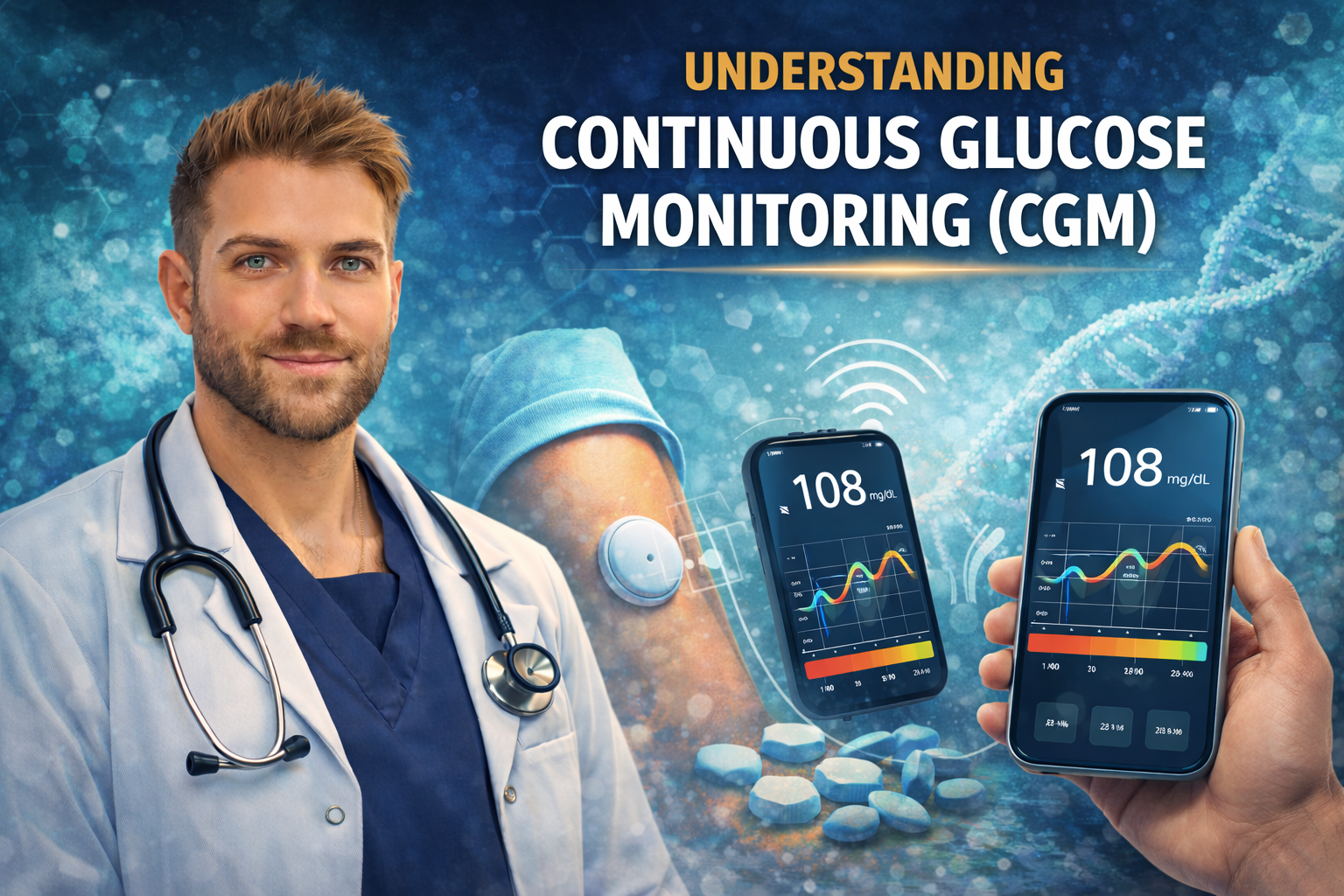
A CGM system consists of three main parts: a small sensor placed under your skin (usually on your abdomen or arm), a transmitter that sends data wirelessly, and a receiver (which can be a dedicated device or your smartphone) that displays your glucose readings.[5]
How Does CGM Work in Daily Life?
The sensor measures glucose in the fluid between your cells (called interstitial fluid) every few minutes, providing continuous information about your glucose levels. Most modern CGM devices automatically send this information to your phone or receiver without you needing to do anything.[1][6]
You can see your current glucose level, whether it's rising or falling, and how quickly it's changing. The device can also alert you when your glucose is getting too high or too low, giving you time to take action before it becomes a problem.[2][6]
Most sensors need to be replaced every 7 to 14 days, depending on the type of device you use. Many current systems don't require fingerstick calibration, making them easier and more convenient to use.[1][5]
What Are the Benefits of Using CGM?
Better Blood Sugar Control
Multiple studies have shown that people who use CGM regularly achieve better blood sugar control than those who rely only on fingerstick testing. On average, CGM users see their hemoglobin A1c (the measure of average blood sugar over 3 months) decrease by about 0.3% to 0.5%.[1][4][7]
This improvement happens across all types of diabetes—whether you have type 1 diabetes, type 2 diabetes treated with insulin, or even type 2 diabetes managed without insulin.[1][4][8]
Reduced Risk of Low Blood Sugar (Hypoglycemia)
One of the most important benefits of CGM is reducing dangerous episodes of low blood sugar. Studies show that CGM can reduce the time you spend with low glucose levels and decrease your risk of severe hypoglycemia that requires emergency care.[2][3][1]
For older adults with type 1 diabetes, CGM reduced time spent with low blood sugar by about 40 minutes per day.[9] The alerts warn you before your glucose drops too low, giving you time to eat or drink something to prevent a serious problem.[2]
Fewer Emergency Visits and Hospitalizations
Research involving thousands of people with diabetes has shown that using CGM leads to fewer emergency room visits and hospitalizations for both low and high blood sugar complications.[1][3]
In one large study, people who started using CGM had a 31% reduction in hypoglycemia-related emergency visits and hospitalizations.[2] These benefits continued even after 2 years of CGM use.[1]
More Time in Your Target Range
CGM helps you spend more time with your glucose in the healthy range (typically 70-180 mg/dL). The goal is to be in this range more than 70% of the time, which equals about 17 hours per day.[1][10]
By seeing how your glucose responds to different foods, exercise, stress, and medications, you can make better decisions throughout the day to keep your levels stable.[7]
Better Understanding of Your Diabetes
CGM provides detailed information about patterns in your glucose levels that you might miss with fingerstick testing. You can see how different meals affect your glucose, how exercise impacts your levels, and what happens overnight while you're sleeping.[7]
This information helps you and your healthcare team make more informed decisions about your insulin doses, medications, and lifestyle choices.[2]
Improved Quality of Life
Many people using CGM report feeling less stressed about their diabetes and more confident in managing low blood sugar.[11][12] Parents of children with diabetes also experience reduced worry and anxiety when their child uses CGM.[1]Studies show that CGM users experience less diabetes-related distress and greater satisfaction with their diabetes management.[1][11]
Who Should Use CGM?
The American Diabetes Association recommends CGM for:[1]
- All people with type 1 diabetes
- People with type 2 diabetes who take insulin (especially multiple daily injections)
- People who experience frequent low blood sugar or are unaware when their glucose is dropping
- Pregnant women with type 1 diabetes
- Anyone whose diabetes management would benefit from continuous glucose information
Even people with type 2 diabetes who don't use insulin may benefit from CGM, as recent studies show improvements in blood sugar control and increased satisfaction.[1][4]
Tips for Successful CGM Use
- Wear It Consistently: The benefits of CGM are greatest when you wear it every day. Studies show that people who use their CGM more frequently achieve better blood sugar control.[1]
- Learn to Interpret the Data: Your healthcare team will teach you how to read the glucose trends and respond appropriately. The trend arrows showing whether your glucose is rising or falling are just as important as the current number.[6]
- Share Your Data: Most CGM systems allow you to share your glucose information with family members, caregivers, or your healthcare team. This can provide added safety and support.[2][6]
- Address Skin Issues: Some people experience skin irritation from the sensor adhesive. If this happens, talk to your healthcare team about solutions to help you continue using the device comfortably.[1]
- Use the Information: CGM is most helpful when you use the data to make decisions about food, exercise, and medication. Work with your healthcare team to develop an action plan based on your CGM readings.[5]
What to Expect
When you first start using CGM, there may be a learning curve. You'll need to learn how to insert the sensor (or have it inserted for you), how to read the data, and how to respond to alerts. Most people find that CGM becomes easier and more intuitive with time.[6]
The wealth of information from CGM can initially feel overwhelming, but it becomes an invaluable tool for managing your diabetes. Many users report that they can't imagine going back to managing their diabetes without it.[13]
Talk to Your Healthcare Team
If you're interested in CGM, discuss it with your doctor or diabetes educator. They can help you determine if CGM is right for you, which system would work best for your needs, and how to get started. They'll also provide training on how to use the device and interpret the data effectively.
CGM represents a significant advance in diabetes care, offering you more information, better control, and greater peace of mind in managing your condition.
Written by Dr Michael Roger
Family Medicine Consultant
References
7. Diabetes Technology: Standards of Care in Diabetes-2026. American Diabetes Association Professional Practice Committee for Diabetes*. Diabetes Care. 2026;49(Supplement_1):S150-S165. doi:10.2337/dc26-S007.
Association of Real-time Continuous Glucose Monitoring With Glycemic Control and Acute Metabolic Events Among Patients With Insulin-Treated Diabetes. Karter AJ, Parker MM, Moffet HH, Gilliam LK, Dlott R. JAMA. 2021;325(22):2273-2284. doi:10.1001/jama.2021.6530.
Initiation of Continuous Glucose Monitoring Is Linked to Improved Glycemic Control and Fewer Clinical Events in Type 1 and Type 2 Diabetes in the Veterans Health Administration. Reaven PD, Newell M, Rivas S, et al. Diabetes Care. 2023;46(4):854-863. doi:10.2337/dc22-2189.
Diagnosis and Treatment of Type 2 Diabetes in Adults. Kalyani RR, Neumiller JJ, Maruthur NM, Wexler DJ. JAMA. 2025;334(11):984-1002. doi:10.1001/jama.2025.5956.
Guidelines and Recommendations for Laboratory Analysis in the Diagnosis and Management of Diabetes Mellitus. Sacks DB, Arnold M, Bakris GL, et al. Diabetes Care. 2023;46(10):e151-e199. doi:10.2337/dci23-0036.
American Association of Clinical Endocrinology Clinical Practice Guideline: The Use of Advanced Technology in the Management of Persons With Diabetes Mellitus. Grunberger G, Sherr J, Allende M, et al. Endocrine Practice : Official Journal of the American College of Endocrinology and the American Association of Clinical Endocrinologists. 2021;27(6):505-537. doi:10.1016/j.eprac.2021.04.008.
Glycaemic Management in Diabetes: Old and New Approaches. Ceriello A, Prattichizzo F, Phillip M, et al. The Lancet. Diabetes & Endocrinology. 2022;10(1):75-84. doi:10.1016/S2213-8587(21)00245-X.
Continuous Glucose Monitoring. Bergenstal RM, Martens TW, Beck RW. JAMA. 2025;334(24):2220-2222. doi:10.1001/jama.2025.19197.
Effect of Continuous Glucose Monitoring on Hypoglycemia in Older Adults With Type 1 Diabetes: A Randomized Clinical Trial. Pratley RE, Kanapka LG, Rickels MR, et al. JAMA. 2020;323(23):2397-2406. doi:10.1001/jama.2020.6928.
Current Management of Glycemia in Children with Type 1 Diabetes Mellitus. Sperling MA, Laffel LM. The New England Journal of Medicine. 2022;386(12):1155-1164. doi:10.1056/NEJMcp2112175.
Change in Hemoglobin A1c and Quality of Life With Real-Time Continuous Glucose Monitoring Use by People With Insulin-Treated Diabetes in the Landmark Study. Gilbert TR, Noar A, Blalock O, Polonsky WH. Diabetes Technology & Therapeutics. 2021;23(S1):S35-S39. doi:10.1089/dia.2020.0666.
The Impact of Continuous Glucose Monitoring on Markers of Quality of Life in Adults With Type 1 Diabetes: Further Findings From the DIAMOND Randomized Clinical Trial. Polonsky WH, Hessler D, Ruedy KJ, Beck RW. Diabetes Care. 2017;40(6):736-741. doi:10.2337/dc17-0133.
Continuous Glucose Monitoring: A Review of the Evidence in Type 1 and 2 Diabetes Mellitus. Lin R, Brown F, James S, Jones J, Ekinci E. Diabetic Medicine : A Journal of the British Diabetic Association. 2021;38(5):e14528. doi:10.1111/dme.14528.
