Gastroesophageal Reflux Disease (GERD): A Patient Guide
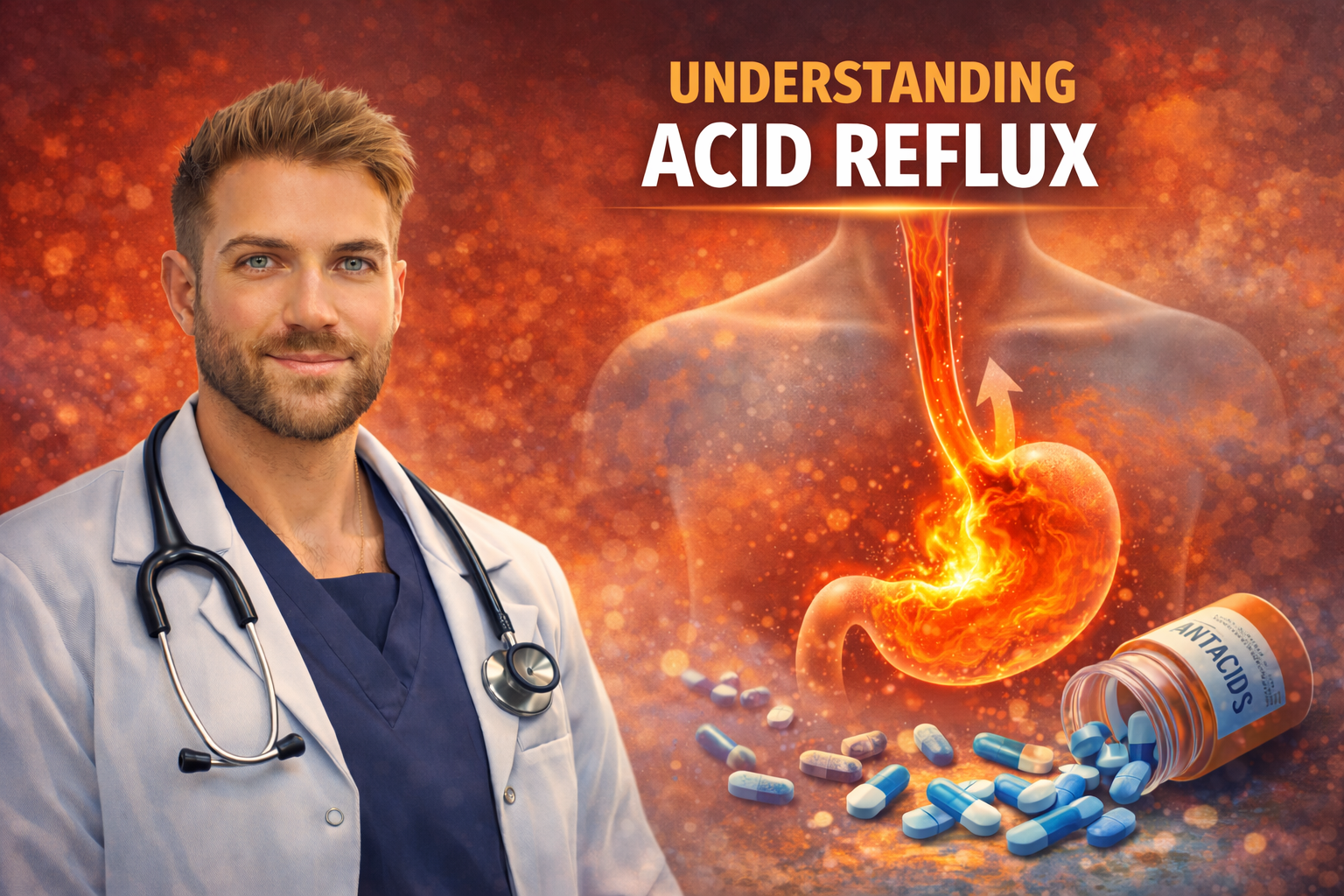
What is Gastroesophageal Reflux Disease (GERD)?
Gastroesophageal reflux disease (GERD) is a condition in which stomach acid and contents flow backward into the esophagus (the tube connecting your mouth to your stomach), causing bothersome symptoms or complications.[1][2] This is a very common problem affecting approximately 15% to 25% of adults in developed countries.[2]
Normally, a circular muscle called the lower esophageal sphincter acts like a valve between your esophagus and stomach, preventing stomach contents from flowing backward. When this sphincter doesn't work properly or relaxes too often, reflux occurs.[1][2][3] A hiatal hernia (when part of the stomach pushes up through the diaphragm into the chest) is a common anatomic problem that can make reflux worse.[2]
What Are the Symptoms of GERD?
Typical symptoms of GERD include:[2][1]
- Heartburn: a burning sensation rising from your stomach or lower chest toward your neck, often occurring after meals
- Regurgitation: the sensation of stomach contents (often acidic or bitter) coming back up into your mouth
- Chest pain: can feel similar to heart-related chest pain
Less common symptoms may include:[2][1][4][3]
- Chronic cough
- Hoarseness or voice changes
- Sensation of a lump in your throat
- Difficulty swallowing (dysphagia)
- Asthma or wheezing
- Dental erosion
- Bloating and belching
- Chronic sore throat
Important: If you experience chest pain, it's essential to rule out heart problems first. If you have difficulty swallowing, unintentional weight loss, or bleeding, see your doctor immediately, as these symptoms may indicate more serious problems.[2][3]
What Are the Possible Complications of GERD?
Without proper treatment, GERD can lead to:[2][5]
- Esophagitis: inflammation and erosions of the esophagus lining (occurs in 18% to 25% of patients with GERD)
- Esophageal stricture: narrowing of the esophagus from scar tissue, making swallowing difficult
- Barrett's esophagus: a change in the esophagus lining that slightly increases the risk of esophageal cancer (occurs in 5% to 12% of patients with GERD)[4][2][5]
However, it's important to know that only a very small number of patients with GERD develop esophageal cancer during their lifetime. People with Barrett's esophagus have approximately a 0.2% to 0.5% annual rate of developing esophageal cancer.[5]
What Lifestyle Changes Can Help?
Lifestyle modifications are the first step in treatment and can significantly improve your symptoms:[1][4][6]
Weight Loss: If you're overweight, losing weight (even a small amount) can substantially reduce GERD symptoms. Studies show a 40% reduction in frequent GERD symptoms in women who reduced their body mass index by 3.5 or more.[1][4]
Eating Habits:
- Avoid eating within 2 to 3 hours before bedtime[1][4]
- Eat smaller, more frequent meals instead of three large meals[4]
- Identify and avoid your personal food triggers[1][4]
Foods and Beverages to Limit:[1][4]
- Coffee, tea, and carbonated beverages (more than 2 cups per day)
- Alcohol
- Spicy and high-fat foods
- Chocolate and peppermint
- Citrus fruits and tomatoes
- Onions
Other Helpful Measures:[1][4]
- Stop smoking: Quitting smoking improves GERD symptoms by 44% after one year[1]
- Elevate the head of your bed by 15 to 20 cm (6 to 8 inches) using blocks under the bed legs or a wedge pillow[1][4]
- Avoid sleeping on your right side: Sleeping on your left side reduces reflux[1]
- Avoid tight-fitting clothing around your waist[4]
- Stay upright during and after meals[4]
- Chew gum to stimulate saliva production, which neutralizes acid[4]
What Medications Are Used to Treat GERD?
1.Proton Pump Inhibitors (PPIs)
PPIs are the most effective medications for treating GERD.[4][2] They reduce acid production in your stomach and usually relieve symptoms. PPIs include omeprazole, lansoprazole, pantoprazole, esomeprazole, and rabeprazole.[2]
How to Take Them:[4][3]
- Take them 30 to 60 minutes before a meal (preferably in the morning), not at bedtime
- Initial treatment: usually 4 weeks for typical symptoms, 8 weeks if esophagitis is present[2]
- All PPIs are similarly effective when taken at equivalent doses[2][1]
Effectiveness:[4][1]
- PPIs heal erosive esophagitis in approximately 84% of patients within 12 weeks
- They completely relieve symptoms in 70% to 80% of patients with esophagitis
- They are significantly superior to H2-receptor antagonists (like ranitidine or famotidine)
Long-Term Use:[2][1]
- If you don't have severe esophagitis or Barrett's esophagus, your doctor may try to reduce or stop PPIs after initial treatment
- Use the lowest effective dose that controls your symptoms[2]
- Patients with severe esophagitis (Los Angeles grade C or D) or Barrett's esophagus should continue PPIs indefinitely[1]
- Some patients can use PPIs "on-demand" (only when symptoms occur)[1]
Safety: While some observational studies have suggested potential risks with long-term PPI use (infections, fractures, kidney disease), the evidence is not strong enough to recommend stopping necessary treatment. A large clinical trial found only a slight increase in intestinal infections, with no other significant adverse effects.[4]
2.H2-Receptor Antagonists
These medications (such as famotidine) also reduce acid production but are less effective than PPIs.[4][1] They may be used for mild symptoms or as additional treatment.
When Is Surgery Considered?
Surgery may be an option for certain patients:[4][1][2][7]
Potential Candidates:
- Patients who don't want to take PPIs long-term
- Patients with severe regurgitation
- Patients with a large hiatal hernia (>5 cm)
- Patients whose symptoms persist despite taking PPIs twice daily
- Young, healthy patients with objectively confirmed GERD
Types of Surgery:[4][1][7]
- Laparoscopic fundoplication: the "standard" procedure that strengthens the anti-reflux barrier by wrapping the upper part of the stomach around the esophagus
- Magnetic sphincter augmentation (LINX): a ring of magnetic beads placed around the esophagus to strengthen the sphincter
- Transoral incisionless fundoplication (TIF): a less invasive endoscopic procedure for carefully selected patients without large hiatal hernias
Results: Surgery can be effective, but more than 25% of patients resume taking PPIs during long-term follow-up (>5 years).[4] A thorough evaluation (endoscopy, esophageal manometry, pH monitoring) is necessary before considering surgery.[4][2]
What Is the Long-Term Outlook?
Most patients with GERD can be successfully treated with lifestyle modifications and medications.[2] GERD is a chronic condition that often requires long-term management, but it does not increase overall mortality risk.[2]
Key Points for Long-Term Management:[2][1]
- Maintain lifestyle changes even if you're taking medications
- Use the lowest dose of PPI that controls your symptoms
- If your symptoms are well controlled without severe esophagitis, discuss with your doctor the possibility of reducing or stopping PPIs
- See your doctor regularly to reassess your treatment
- Patients with Barrett's esophagus need regular surveillance endoscopy
When Should You See Your Doctor?
Consult your doctor if:[2][3]
- Your symptoms don't improve after 4 to 8 weeks of PPI treatment
- You have difficulty swallowing
- You're losing weight unintentionally
- You have bleeding or vomit blood
- You have chest pain (seek immediate care to rule out heart problems)
- Your symptoms worsen or change
Conclusion
GERD is a common and treatable condition that can significantly affect your quality of life. A combination of lifestyle modifications and appropriate medications effectively controls symptoms in most patients. Work with your doctor to find the treatment plan that's right for you, and don't hesitate to discuss any concerns about long-term treatment.
Written by Dr Michael Roger
Family Medicine Consultant
References
ACG Clinical Guideline for the Diagnosis and Management of Gastroesophageal Reflux Disease. Katz PO, Dunbar KB, Schnoll-Sussman FH, et al. The American Journal of Gastroenterology. 2022;117(1):27-56. doi:10.14309/ajg.0000000000001538.
Gastroesophageal Reflux Disease: A Review. Maret-Ouda J, Markar SR, Lagergren J. JAMA. 2020;324(24):2536-2547. doi:10.1001/jama.2020.21360.
Esophageal Motility Disorders and Gastroesophageal Reflux Disease. Mittal R, Vaezi MF. The New England Journal of Medicine. 2020;383(20):1961-1972. doi:10.1056/NEJMra2000328.
Gastroesophageal Reflux Disease. Fass R. The New England Journal of Medicine. 2022;387(13):1207-1216. doi:10.1056/NEJMcp2114026.
Barrett Esophagus: A Review. Sharma P. JAMA. 2022;328(7):663-671. doi:10.1001/jama.2022.13298.
American Society for Gastrointestinal Endoscopy Guideline on the Diagnosis and Management of GERD: Summary and Recommendations. Desai M, Ruan W, Thosani NC, et al. Gastrointestinal Endoscopy. 2025;101(2):267-284. doi:10.1016/j.gie.2024.10.008.
AGA Clinical Practice Update on the Personalized Approach to the Evaluation and Management of GERD: Expert Review. Yadlapati R, Gyawali CP, Pandolfino JE. Clinical Gastroenterology and Hepatology : The Official Clinical Practice Journal of the American Gastroenterological Association. 2022;20(5):984-994.e1. doi:10.1016/j.cgh.2022.01.025.
